
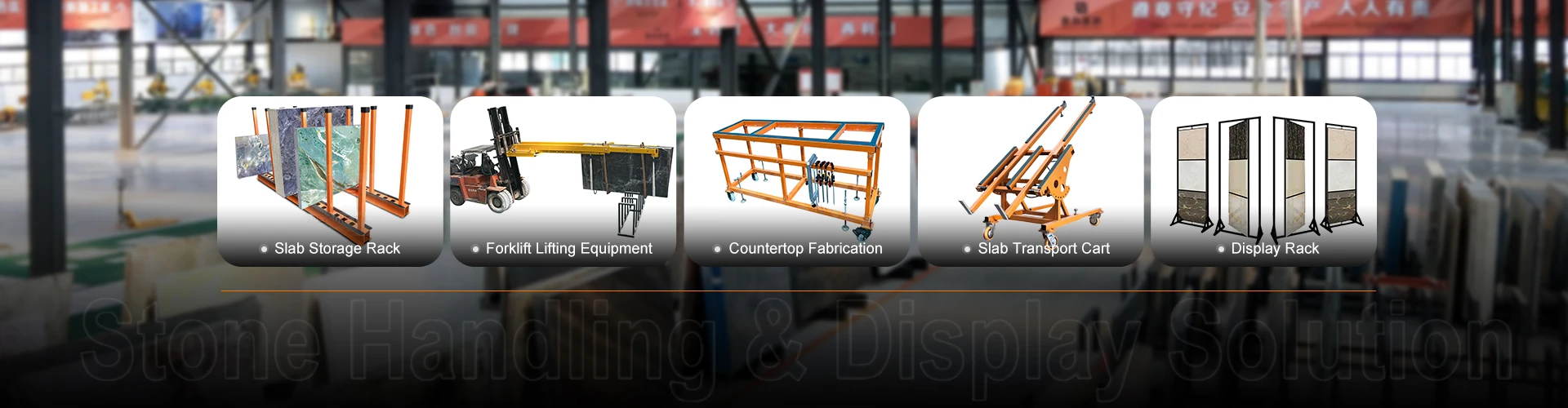
Move Slabs Efficiently Between Storage and Production
Match storage, lifting and transfer equipment to the actual slab route, load, aisle conditions and lifting equipment in your workshop.

Plan the Slab Route from Storage to Production
Store
Keep slabs accessible for the next handling step.
Pick Up
Provide access for the selected lifting method.
Transfer
Move slabs through available aisles and turning areas.
Position
Place the slab at the required workstation.
Move On
Transfer finished material or offcuts to the next area.


Match Equipment to the Handling Task
| Handling Task | Equipment | Check Before Selection |
|---|---|---|
| Slab storage and staging | A-frame racks or slab storage racks | Slab size, load, loading direction and access |
| Internal transfer | Slab carts or transport A-frames | Aisle width, floor condition and turning space |
| Slab lifting and positioning | Clamp lifters or lifting attachments | Material, load, slab dimensions and lifting method |
| Forklift lifting | Forklift boom systems | Forklift capacity, fork size, reach and working height |
| Fabrication support | Stone working tables | Workpiece size, working height and operator access |


What Changes the Equipment Choice
Slab Size
Confirm material, dimensions, thickness and handling sensitivity.
Maximum Load
Use the heaviest expected slab or bundle.
Aisle Space
Check aisle width, corners, doors and turning space.
Floor Condition
Check joints, thresholds, slopes and wheel travel surfaces.
Lifting Equipment
Confirm forklift, crane or hoist data before matching attachments.
Handling Frequency
Frequent transfer can change cart, wheel and access requirements.
Check Every Handover Point
Each handling step must work with the next. Check access, dimensions and lifting interfaces before order confirmation.
- Forklift capacity and fork dimensions
- Crane or hoist lifting method
- Clamp or attachment suitability
- Cart width versus aisle and doorway width
- Wheel type and floor condition
- Working table height
Capacity Is Only One Part of the Decision
Load shape, lifting geometry, reach, floor route and transfer method also affect equipment selection.
Send Your Workshop Conditions
Include slab dimensions, maximum weight, material, aisle width, forklift or crane information, and photos of the pickup and drop-off areas.
Check the Complete Handling Route
Mark Pickup and Drop-Off Points
Identify storage, fabrication and final transfer locations.
Measure the Route
Record aisles, doors, turning areas and floor changes.
Confirm the Lifting Method
Check forklift, crane or hoist compatibility with the load.
Use the Maximum Load
Base equipment selection on the largest and heaviest expected slab.
Check the Handover
Make sure each device can transfer the slab to the next stage.
Recommended Equipment for In-Plant Slab Handling
Choose handling equipment around the slab load, workshop route, aisle space and the lifting equipment already available in your plant.

Stone Transfer Dolly
For moving stone slabs between storage, fabrication and other work areas where route width and floor conditions need to be considered.
View Product →
Granite Slab Dolly
A slab transfer option for workshop movement where slab dimensions, handling frequency and available aisle space affect equipment choice.
View Product →
Stone Slab Lifting Fixture
For slab pickup and positioning where load, slab dimensions and the available crane or hoist need to be matched.
View Product →
Forklift Boom Pole
For forklift-based lifting where forklift capacity, fork dimensions, working height and the intended load must be checked together.
View Product →What We Need to Match the Equipment
Slab Details
- Material type
- Typical and maximum slab dimensions
- Maximum slab or bundle weight
- Surface or edge protection requirements
- Required quantity
Workshop Details
- Workshop layout or photos
- Aisle and doorway dimensions
- Floor condition
- Forklift, crane or hoist specifications
- Pickup and drop-off locations
- Destination country
In-Plant Slab Handling Questions
It depends on load, aisle space, route, handling frequency and the lifting equipment already available.
Measure aisle width, turning space, door openings, thresholds and available space at pickup and drop-off points.
Compatibility depends on dimensions, weight, rigidity, surface sensitivity and the intended pickup method.
Provide rated capacity, fork dimensions and spacing, working height, load center information where available, and the intended load.
Yes. Send the layout, route dimensions, slab data and photos of the main handling areas.
Send Your Slab and Workshop Details
Share the load, route and lifting conditions so we can match equipment to your handling process.
Please Include
- Slab material and dimensions
- Maximum weight
- Workshop layout and aisle width
- Forklift, crane or hoist information
- Pickup and drop-off locations
- Quantity and destination country