
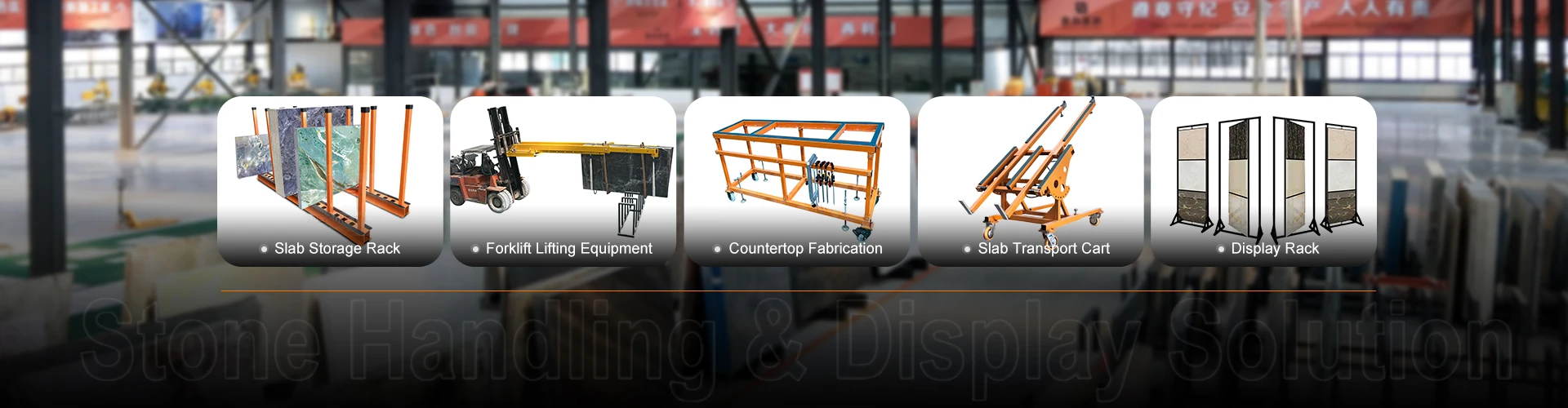
Plan Slab Handling Around the Way Your Workshop Actually Works
Stone slabs move through receiving, staging, lifting, transfer, fabrication and dispatch. Matching equipment to the full route helps reduce unnecessary re-handling and keeps material movement organized.

Match Equipment to Each Handling Stage
The right setup depends on slab size and weight, storage position, lifting method, travel route and movement frequency.


See Stone Fabrication Handling in Motion
Typical Equipment Directions for a Fabrication Shop
| Workshop Task | Equipment Direction | Main Selection Factors |
|---|---|---|
| Receiving and temporary staging | A-frame racks or slab storage racks | Slab size, load, storage layout and loading access |
| Movement between work areas | Slab transport carts or transport A-frames | Route length, floor condition, turning radius and movement frequency |
| Lifting and positioning slabs | Clamp lifters, lifting accessories or forklift boom systems | Maximum load, slab dimensions, lifting method and available forklift or crane |
| Supporting fabrication work | Stone working tables | Workpiece dimensions, working height, access around the slab and process requirements |
| Packing and outbound handling | Transport racks, A-frames and lifting equipment | Packing method, vehicle or container conditions, lifting access and destination requirements |
| Offcut and scrap collection | Stone waste containers | Waste type, collection point, forklift access and discharge method |


Five Decisions to Make Before Choosing Handling Equipment
Define the Load
Confirm material, slab dimensions, thickness and maximum load.
Map the Route
Check aisle width, floor condition, turning space, door clearances and travel distance.
Confirm Lifting Equipment
Confirm forklift, crane or hoist capacity, working height, fork dimensions and lifting points.
Set the Handling Frequency
Handling frequency affects cart, rack, wheel and access requirements.
Plan the Handover
Plan the transfer from internal handling to packing, truck loading or container loading.
When Standard Dimensions Do Not Fit
Provide slab data, workshop drawings, photos and operating conditions when standard dimensions do not fit.
Check the Interfaces Between Equipment
Check each handover point. Carts must fit the route, lifting attachments must match available equipment, and racks must allow practical loading and unloading.
- Forklift capacity and fork dimensions
- Crane or hoist lifting method
- Slab contact and support points
- Cart wheel type and floor condition
- Rack loading direction and access space
- Working table height and operator access
- Outbound loading and packing method
Build the Workflow Around Known Operating Limits
Confirm load limits, equipment compatibility and movement paths before selection. Follow the operating and inspection requirements for each device.
Before Order Confirmation
Share slab size, maximum weight, material, workshop layout, lifting equipment and handling steps so the configuration can be checked before order.
Recommended Equipment for Stone Fabrication
Combine transfer, lifting and work-support equipment around the actual route between storage, fabrication and outbound handling.

Fabrication Table with Levelling Posts
For supporting slab fabrication tasks where workpiece size, working height and access around the material need to be considered.
View Product →
Stone Transfer Dolly
For moving slabs between storage and work areas where aisle width, floor condition and transfer distance affect the handling route.
View Product →
Stone Slab Lifting Fixture
For slab pickup and positioning where slab dimensions, load and the available crane or hoist need to be matched.
View Product →
Forklift Boom Pole
For forklift-based lifting where forklift capacity, fork dimensions, lifting height and the intended load need to be checked together.
View Product →What to Send for a More Useful Recommendation
Material & Load
- Stone, quartz, ceramic or other slab material
- Typical and maximum slab dimensions
- Maximum single load or slab bundle weight
- Surface or edge protection concerns
Workshop & Handling Conditions
- Workshop layout or reference photos
- Aisle width and floor condition
- Forklift, crane or hoist information
- Required movement sequence and daily handling frequency
- Required quantity and destination country
Stone Fabrication Workflow Questions
Start with the actual material flow: receiving, storage, lifting, transfer, fabrication, packing and waste handling. Prioritize the stage that controls the rest of the route.
Not automatically. Check dimensions, weight, rigidity, surface sensitivity and handling method for each material before confirming equipment.
Provide forklift rated capacity, fork dimensions, usable lifting height, load center information where available, and the intended load.
Where customization is available, provide slab dimensions, load, available space, handling route, lifting equipment data, drawings and workshop photos.
Check load capacity, slab dimensions, loading direction, access space, floor condition, lifting method, transfer height and each handover point.
Send Your Slab Data and Workshop Conditions
Send your slab data and workshop conditions for equipment matching across storage, lifting, transfer, fabrication support and outbound handling.
Include These Details
- Material type and slab dimensions
- Maximum slab or bundle weight
- Workshop layout or photos
- Forklift, crane or hoist information
- Required handling sequence
- Quantity and destination country